Marmon Series 34B Roadster, and a little history of the brand
Many names have attained legendary status based on achievements at the Indianapolis Motor Speedway: Marmon was the first. It was 1911 and the automotive world was turbulent and exciting, yet only a glimmer of what it was to become. The Marmon Wasp, with an average speed of 74.59 mph, won that inaugural Indianapolis 500 race. The effort was quite impressive considering that automobiles were not far removed from their horseless carriage days. Marmon was a company that pushed for changes that would make them the champion of new technologies. Their automotive creations were the fruition of an eclectic, enthusiastic bunch of engineers building cars in the Brickyard’s backyard. Innovative use of aluminum in the body, cowl, doors, suspension, running gear and engines attests to the fact that the Marmon engineering team was obsessed with being more than just another motorcar. The company built a reputation based on the skills of producing high quality lightweight cars with powerful engines.
James McCaw, president of the Marmon Club, would argue convincingly that the status of owning a Marmon was higher than even that of owning a Cadillac, Locomobile, and Packard. He notes with pride that the speed and endurance of Marmon automobiles made it the “notorious” choice of moonshiners who conducted alcohol runs from Canada into the U.S. during Prohibition. McCaw claims the Marmons were so fast that, when moonshiners were captured by police, their Marmons were locked up in special storage yards to prevent anyone else from using them.
Supportive of these statements is the advertised declaration that all 1921 series 34B Speedsters were guaranteed to do at least 85 mph. The Marmon series 34, which was produced from 1916 to 1924, was designed to surpass the benchmark speed of 70 mph. Few motorcars could match this claim. Furthermore, Marmons had established themselves in other unique ways. They were the only cars used in Europe by General Pershing during World War I. In the early ’20s, Barney Oldfield navigated across the United States in an unheard of six days behind the wheel of a Marmon Speedster.
High performance, innovative design and limited production numbers have combined to make Marmons a collector’s favorite.
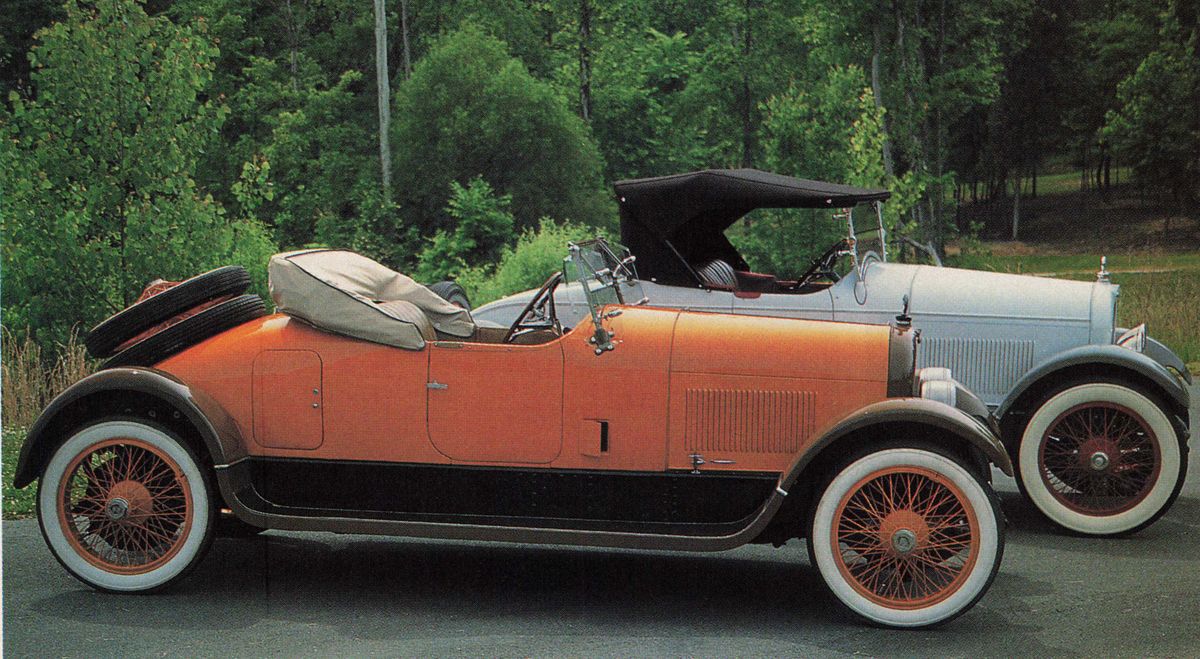
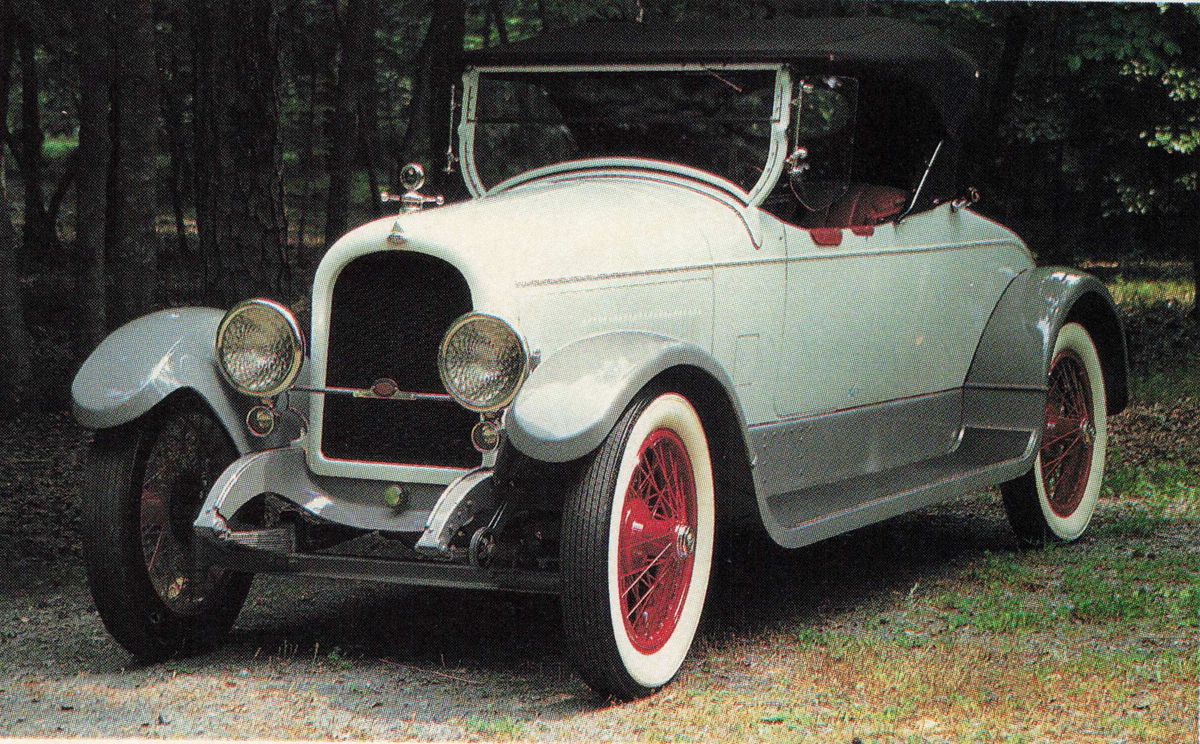
1921 Series 34B Roadster
Dr. Russ Rogers brought home a 1921 Marmon roadster 20 years ago. He admittedly bought it because of the Marmons reputation for being “big, fast, and expensive.” According to Marmon expert James McCaw, the Series 34 was made in models A to C from 1916 to 1924, but Rogers discovered that his 1921 34B roadster was not supposed to exist. After investigating factory records, Rogers learned Marmon never Officially released the standard roadster model until 1924. Rogers also conferred with Marmon author and historian George Hanley. He learned his car was a one-of-a-kind. It is unclear whether it originated from the factory, one of Marmon’s outside suppliers, or an enterprising Marmon dealer. This was possible because Marmons were often designed as custom models that could accept a variety of individualized body designs. Depending on the options desired, a car of this caliber could be styled to the tastes of individual customers. Rogers acquired the Marmon in “very good original condition,” but he decided to complete an overall restoration on this very special roadster.
While the car was in good condition, the biggest challenges came from locating or fabricating items that were missing.
For example, the hub caps on the 34B are made of 100 percent German silver. While the car had retained the original hub caps, three of them were missing the distinctive Marmon emblem. Rogers, a dentist, used dental mold and casting procedures to reproduce the missing emblems. The process involved making a synthetic mold of the existing emblem, recasting three additional emblems out of rubber, and painting them to match the Marmon emblem.
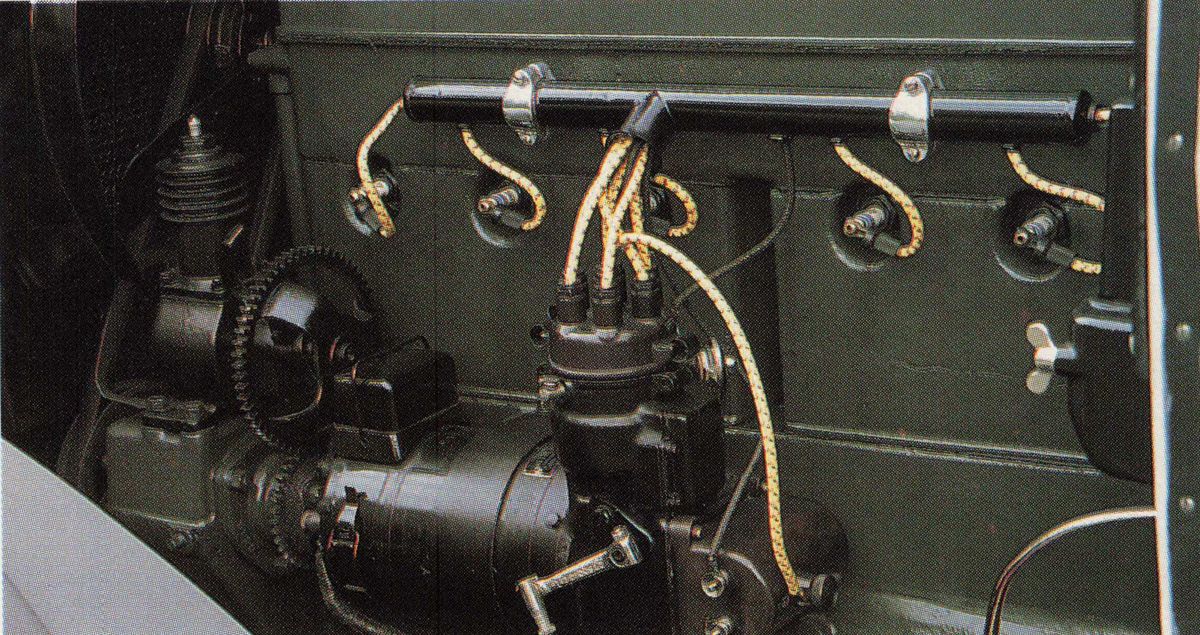
Several rubber clamps, designed to secure the electrical wires in the engine compartment, were also missing. Rogers was also able to replace the missing clamps by devising a casting process similar to the one used on the hub cap emblems. Because Marmon parts are hard to come by, Rogers advises potential buyers to purchase cars that are as complete as possible. During the restoration of this Marmon, Roger Lyons, of Sanford, South Carolina, applied the two-tone lacquer paint. Lyons also reupholstered the leather interior.
An impressive 340-cubic-inch, overhead-valve, six-cylinder engine sits squarely between the frame rails. Predictably there is an extensive use of aluminum throughout the engine. The steel sleeves in the cylinders, and the block (two three-cylinder iron castings) are just about the only components that are not aluminum. Marmon once used all aluminum cylinder sleeves, in the 1916 Model 34B, but abandoned the application after encountering too many problems with expansion and contraction of the cylinders.
The power was transferred through a three-speed, non-synchronized, manual gearbox, with a leather-faced clutch clamping down on the flywheel. Steering is worm and gear, with its effort being “very hard,” according to Rogers. He says that turning the Marmon around on a tight street “requires a lot of muscle.”
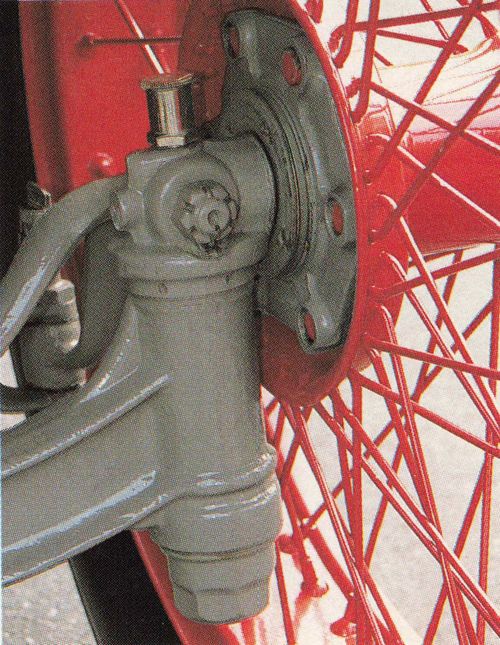
Like most cars of that era, the Marmon Standard Roadster featured mechanical brakes on the rear wheels only. It was still a common belief at the time that front brakes would cause an automobile to spin out of control. Consequently, rear brakes were the norm. The Marmon, like many other cars of the era, actually has two sets of brakes in the rear, with the second set being used for the emergency brake. As can be expected, the braking performance on the Marmon is marginal compared to modern cars.
The suspension system on the Marmons is exceptional. Up front it featured semi-elliptical transverse leaf springs, a design very similar to that found on the rear of modern Chevrolet Corvettes. In the rear, another semi-elliptical transverse leaf spring was used, then another leaf spring was placed upside-down on top of the lower spring. This “piggyback” rear suspension contributed to exemplary handling and ride. All Marmon series 34 cars shared this highly effective suspension design. Expense was apparently not an issue when the Marmon engineers focused their attention on the interior of the Series 34B.
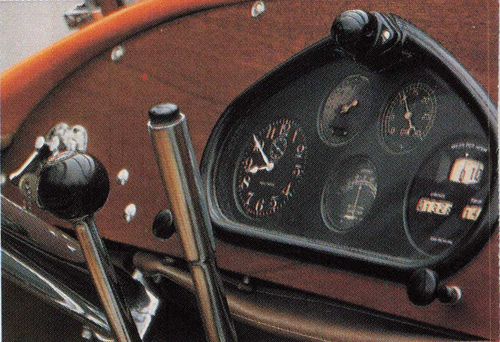
The dashboard is pure mahogany, with an instrument cluster consisting of ammeter, oil pressure and fuel gauges, a speedometer, and a clock. As was the Marmon custom, an owner was unlikely to want anything more. Rogers recommends the Marmon club to anyone who is interested in purchasing and/or restoring one of these fine cars. Through the club, he was able to locate most of the missing parts necessary to complete his restoration. Rogers noted that, according to the grapevine, a recent restoration of the original Barney Oldfield cross-country roadster cost well over $100,000 to complete. The Oldfield Marmon was missing a significant amount of parts when the restoration was started. Overall, Rodgers’ standard roadster has been reliable for the many years that he has owned it. He has basically treated it as a show car since he completed the restoration, and despite the fact that it’s a one-of-a-kind, he plans to start driving the car again in local touring events and Marmon Club outings.
1922 Series 34B Speedster
When Clay Thomas bought his Marmon Speedster in 1988, the car had already been restored by the previous owner, Herb Watts. By the time it passed into Thomas’ hands, the car had been driven and shown extensively. Thomas says he bought the car because, “it was a good runner, and it’s a fun car. It’s one that you can take on tours and rallies. It’s very enjoyable to drive because it’s lightweight, powerful and big. It makes a lot of noise. It makes you feel good.” He continues to drive the car on a weekly basis.
Availability was also a big factor in purchasing this particular car. Few Marmons were produced by the Indianapolis manufacturer and they are a rare find in the modern world. Many Marmons were scrapped for their precious aluminum during World War II. Because the Series 34 had an eight-year production run, they’re the easiest to find. Thomas had just finished a 12-year restoration on a beautiful 1928 Auburn, and he was looking for another car that had already been restored. As he puts it, “I wanted to be living long enough to drive it!”
The speedster, like all Marmons, was designed, in part, by Howard Marmon who not only was president of the company but also the chief engineer. Thomas backs up the claims of high performance based on the combination of light weight and high horsepower. He contends that fast acceleration was essential considering the Marmon’s expensive price tag.
Thomas’ speedster has a 136-inch wheelbase, with an all-aluminum body and mostly aluminum engine and drivetrain. Like Rogers’ car, the speedster uses the same overhead valve, six-cylinder engine. Marmon offered speedster models in two-seat and four-seat configurations. The main differences between the speedsters and the roadsters (like Rogers’ car) were the lower radiator mounting, the lower cowl area (approximately 4/2 inches), and a different rear end ratio. According to Thomas, the engineering theory in those days wasn't entirely focused on how fast you could go, but also on how slow you could go without having to shift gears. Thomas says that while most cars ran 4.55-to-1 or 4.75-to-1 rear end ratios. His speedster came with a rear end ratio of 3-to-1. This translates to a much higher operating speed when given the opportunity to “let it out.” The lower-ratio rear ends of other non-speedster Marmon models were more suitable to city driving and the capability of driving slow in high gear.
The speedster incorporated much of the same suspension design as other Marmon models, with transverse springs front and back. The body, the rear-end housing and steering gear were also made of aluminum. Like the roadster, the speedster also featured an air compressor mounted inside the engine compartment. An on-board compressor, which was powered off the engine, was a valuable accessory due to the number of flat tires encountered in the early days of motoring.
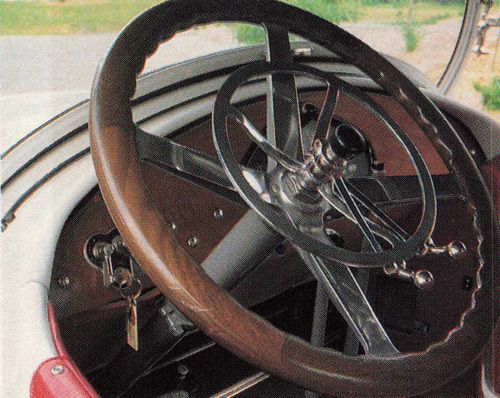
The interior of the speedster is similar to the roadster with one notable exception. According to Thomas, when the engineers designed the lower body structure of the speedster, they discovered the steering wheel was too far from the driver. It was deemed too costly to lengthen the steering column, so a deep dish steering wheel was installed to make up for the 412 inches lost when the cowl area was dropped. The speedster was also designed with a left-foot foot rest, which was unique for the time period.
When asked for advice on buying these rare automobiles, Thomas quickly references the sixteen-cylinder Marmon built between 1930 and 1933 as the ultimate Marmon. While he doesn’t plan on purchasing one, he says the model is quite a find for someone interested in buying Marmon’s “crowning achievement.” He also recommends utilizing the resources of the Marmon Club before jumping into any purchase decisions. Ultimately, Thomas believes buying an old car is an emotional decision. And while some people are in the hobby to make money, his reasons are purely emotional. As he puts it, “I'm in this to drive it. That’s what I enjoy most.”
So you want to buy a Marmon?
As you can tell from the comments of two Marmon owners, these cars require a good deal of research before purchasing. Because the automobiles and the parts are rare, their cost comes at a premium. James McCaw, president of the Marmon club, owns a 1924 model 34C, as well as several additional parts cars. He says that while the sixteen cylinder models are the most desired by collectors, the most popular Marmon is the series 34 because very little changes were made during its production run from 1916 to 1924. McCaw says they are the best choice for availability and parts acquisition. When evaluating a potential Marmon purchase, McCaw says “these cars are pretty straightforward to evaluate. They’re not that complicated.”
His first recommendation is to take the car to a mechanic, knowledgeable in cars of this vintage, to have it evaluated. McCaw says it is essential to do a thorough check of the bodywork for cheap body fillers that have been used to repair the aluminum construction. Because aluminum repairs are generally more expensive than sheetmetal, short cuts in body repair have often been taken. Check the all-aluminum drivetrain and suspension pieces for bends and cracks.
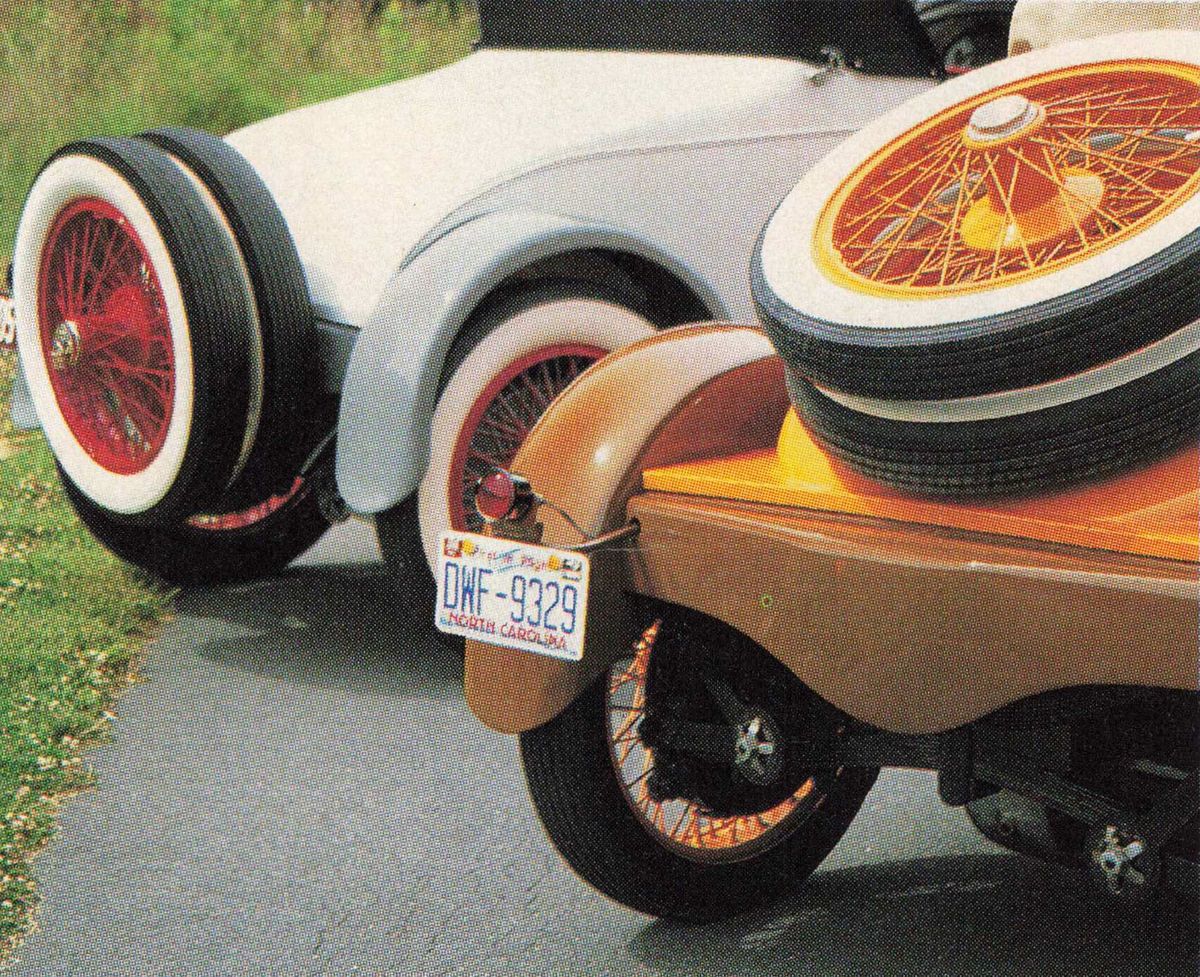
The Marmon Club comprises approximately 300 enthusiasts. Some members own as many as nine Marmons. The Marmon owners can be great sources for missing parts. McCaw claims to have “the largest collection of Marmon Series 34 parts in the country.” The club’s technical advisors are an excellent resource when evaluating a specific Marmon model. Individual advisors are available for each Marmon model, while other Marmon Club members are excellent sources for parts and restoration tips.